

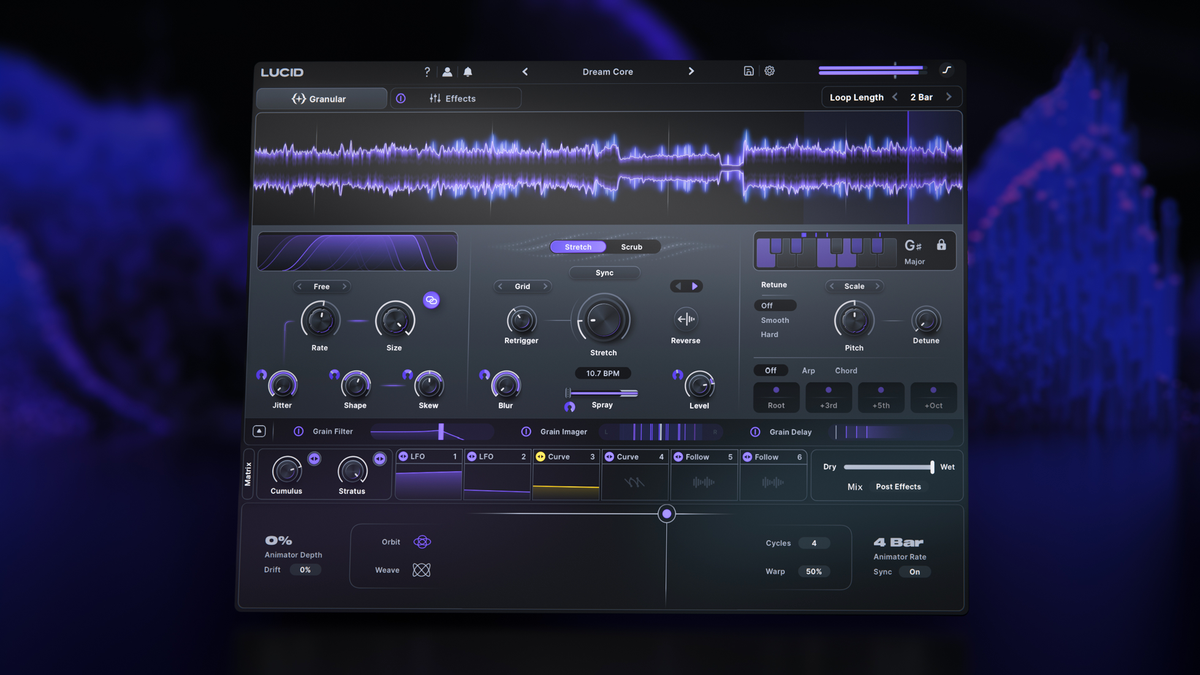
Lucid is the result of years spent exploring granular synthesis and asking what the process could look like if it was built around making music from the start.
We sat down with Minimal Audio head developer Ben Wyss to talk about the ideas behind Lucid, the decisions that shaped its workflow, and what it took to turn those years of experimentation into our dream granular effect.
Where did the original idea for Lucid come from?
Honestly there wasn't one thing that sparked it. Lucid is the culmination of years of using, thinking about, and building granular processors. I've loved making granular sounds since I started doing electronic music almost 20 years ago. Back then I was using Camel Audio's Alchemy (its granular engine now lives inside Logic Pro) and getting lost in all the different ways it could transform sounds.
A lot of what went into Lucid came from years of ideas — mine and the team's — about what our “dream” granular effect would be, and some of those ideas stood out enough to justify a new plugin. On top of that, I just wanted a granular effect that didn't hold back: a full modulation system, built-in effects, useful visuals — everything.

What did you feel was missing from existing granular effects?
I love doing deep sound design sessions with other granular plugins, but it's always felt separate from the music-making process for me. I'd do whole sessions creating sounds and then have to figure out how to get them to work in my track — which usually meant a lot more editing. I really wanted to bridge that gap, so I could put Lucid on a channel in my track and never go down that rabbit hole of resampling and editing. We addressed it a few different ways, but the two big ones: grains stay locked to your scale (so cool with grain clouds and other effects), and stretching and scrubbing stay locked to your timeline.
What's different about how Lucid works under the hood?
Well I don't know exactly how other granular processors are working under the hood, but one thing that's unique about Lucid in my experience is how it uses DAW information like BPM and timeline position to create synchronized movement and perfect loops in real time. This is something that you almost don't notice when using it but I haven't seen other plugins do it in such depth. The other thing is the amount of processing inside of each grain. There's a whole effects chain inside each one, and that unlocks the scale locking as well as super interesting timbral effects like every grain's filter modulating independently.
What were some of the hardest product decisions you had to make during development?
Figuring out how to make the scale locking and pitch controls feel intuitive but also flexible. I think it feels really natural now, but the early versions had more pitch controls, including ways to turn off the pitch detection for zero-latency modes that would no longer scale-lock. It was much more complex, but it let you combine our per-grain pitch correction — an actual pitch detector and shifter on every grain — with the traditional "repitch" approach most granular processors use, where pitch changes by speeding playback up or down.
Simplifying that meant cutting flexibility to make the feature feel effortless. A bit of this is still in there with the modes right above the pitch knob: scale lock with the per-grain shifter, pitch shift freely, or go classic repitch.
Were there any features that fundamentally changed as you built the plugin?
Most of what made it into Lucid was refined over time rather than fundamentally changed — but we tried and cut a ton of things along the way. One example: making the grain window a full ADSR envelope. This was a cool "musical" idea, but it didn't end up sounding different enough to warrant the mental load.
We also tried a lot more grain effects than what shipped, and the test ended up being pretty simple: if an effect didn't sound meaningfully different per-grain versus just running it on all the summed grains, it got cut. That turned out to be true for more effects than I expected, especially on more complex granular patches.
How did you decide how deep Lucid should go without making the workflow feel overly technical?
This kind of problem is a big part of how we design products at Minimal — and granular makes it especially interesting because the technique has such deep academic roots. Reading up on it with books like Curtis Roads' Microsound years ago was really inspiring to me, but it also made clear how big the gap is between those origins and what goes into a music making session today. Closing that gap was kind of the whole deal with Lucid.
We think a lot about what it's like to get to know a new tool — you want the most impactful, clearest controls right up front, with the deeper workflows layered underneath. Lucid is one of our more advanced plugins, and we embraced making it deep, but we tried to keep that layering in mind the whole way through.
The grain effects are a great example. Once we started exploring, it felt like each one (especially the grain delay) could turn into a whole plugin on its own. But we wanted them on the same panel as the main granular controls, since they often need to be adjusted in tandem — so splitting them off into another view wasn't an option. We ended up prioritizing that accessibility over the extra depth. At some point I'd still like to get some of those ideas in there somehow!
How do you personally use Lucid in a track?
I really like to get an arrangement going with the basic layers and a solid tonal progression, and then start putting Lucid on any melodic elements — either to add character to them in place, or to transform them more deeply into additional sounds like pads, transitions, and other ear candy. I find this is a really nice way to get all the layers you might want in a track out of one initial idea, while making each one sound both connected and distinct. I also like to experiment with resampling the entire track through it — a trick I've been doing with granular processors for years, and one of my favorite ways to find things I never would have designed on purpose.
After working on it for so long, what are you most proud of?
It's a bit abstract, but the feeling I get when I use Lucid is what I'm most proud of. Even after building it and using countless other granular effects, I'm still discovering new ways to use and combine what's in there to get sounds that get me excited. If it can still surprise me, I think it'll keep surprising people for a long time — and that it'll have a lasting impact on people's workflows and music.
When creating Lucid, the most important part wasn't any single feature. It’s that the plugin can still lead somewhere unexpected after years of process and experimentation.
That sense of discovery shaped Lucid from the beginning: deep enough to keep exploring, but immediate enough to keep you in the flow of your creative process.
Ready to try Lucid for yourself?