
To celebrate our new expansion season Cinematic Futures, we’re highlighting a handful of film-scoring moments that continue to influence how we think about tone, texture, and cinematic world-building.
Modern cinematic scoring grows out of a portal shaped by artists like John Carpenter, Tangerine Dream, and Vangelis, whose synth-driven cues redefined how atmosphere, harmony, and texture could carry a story. That lineage has evolved into something deeper and more immersive, where sound design and composition form a unified expressive language. Cinematic Futures follows that thread into a more surreal dimension, exploring hybrid textures, warped atmospheres, and synth-driven expression that feels woven directly into the scene.
You can hear this evolution across Cinematic Futures. The moments below highlight the tones and ideas that surface when film scoring pushes just beyond the familiar dimension.
Stranger Things
The opening titles of Stranger Things feel like a doorway into the Upside Down.
Composed by Kyle Dixon & Michael Stein, the cue opens with an arpeggio pulsing in the dark while soft harmonics move at the edges of the frame, adding depth without drawing attention. There’s an unmistakable nod to the early eighties, yet nothing about it feels imitative. The synths move with a depth and clarity that makes the nostalgia feel new again.
Why this resonates for sound designers
This cue works because of how it feels. The arpeggio creates a steady pulse, but the real emotional weight comes from the textures that gather around it. The movement in the harmonics, the shape of the space, and the subtle modulation in the tone all contribute to a sense of something unfolding. It’s a reminder of how atmosphere, pacing, and sonic detail can create an entire world in a matter of seconds. The sound doesn’t just support the scene; it defines the dimension the viewer is stepping into.
How this energy shaped Cinematic Futures
You can hear this influence in the expansion’s pulse-driven patterns and evolving tonal beds, which are designed to drift, breathe, and reshape the emotional contour of the scene from within.
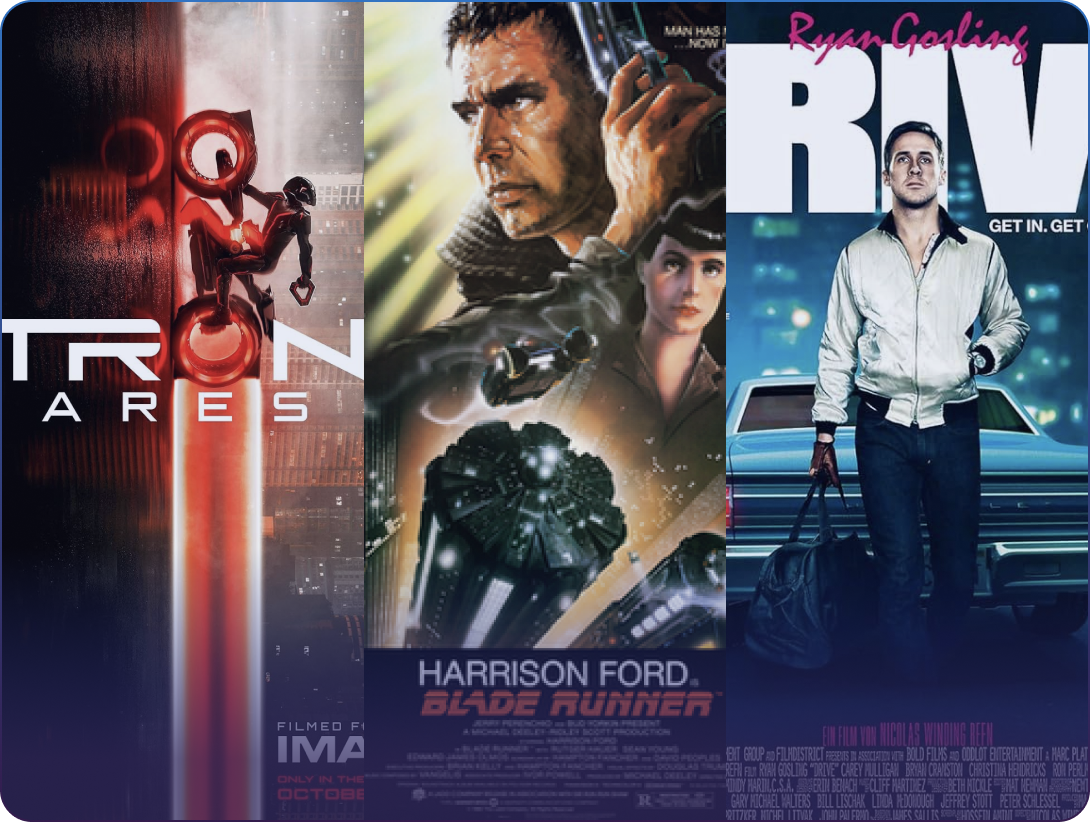
Tron Ares
The score for Tron: Ares feels like the digital world crossing over and downloading into reality, with each sound arriving like something newly materialized.
NIN deliver synth strikes with a clean, metallic edge, and the low end is tightly controlled, adding impact without sacrificing clarity. It’s a controlled intensity—aggressive enough to feel physical, yet disciplined enough to give every element purpose and presence.
Why this resonates for sound designers
This cue demonstrates how intensity becomes cinematic when it’s sculpted rather than stacked. The aggression is deliberate. Distortion is shaped, weighted, and placed with intention. Each layer has its own contour and room to land, and the balance between them keeps the mix defined even at its heaviest. It’s a blueprint for making electronic textures feel massive without losing clarity or dimension.
How this energy shaped Cinematic Futures
You can hear this influence in the expansion’s heavier tonal elements and kinetic synth textures. These sounds lean into grit without sacrificing definition, using saturation, transient detail, and spatial movement to create impact that feels engineered, focused, and alive inside the scene. It connects back to Ares: shaping intensity so it feels part of the world, not layered on top of it.
Bladerunner
Blade Runner became a classic not just through image or story, but through the atmosphere it established. Vangelis’s score weaves into the film like light through fog, shaping mood and meaning long before the plot begins to move.
Long, sustained synth tones stretch across scenes, carrying harmony, noise, and reverb as a single unified gesture. Melodic fragments surface briefly, then dissolve back into atmosphere. The result feels less like a score reacting to the image and more like an environment the image has to move through.
Why this resonates for sound designers
This score is a masterclass in how tone and space can do narrative work. The harmonic language is restrained, but the sound feels expansive because of how it’s shaped. Reverb isn’t decoration here; it’s scale. Modulation isn’t movement for its own sake; it’s slow, deliberate drift. It shows how holding a sound long enough, and shaping it carefully enough, can communicate emotion without relying on constant change.
How this energy shaped Cinematic Futures
That approach shows up in the expansion’s wide, slow-moving pads and harmonic beds designed to feel continuous rather than reactive. These sounds emphasize sustain, depth, and subtle internal motion, allowing scenes to breathe while still carrying emotional weight. It’s the same philosophy you hear in Blade Runner: sound as an environment, not an event.
Drive
Johnny Jewel’s involvement in Drive is inseparable from the film’s final sound, even though he didn’t score it front to back.
Early on, Jewel was positioned to handle more of the music, but concerns emerged around whether he could deliver a full score. That hesitation led the filmmakers to bring in veteran composer Cliff Martinez.
What’s notable is what didn’t change. Jewel’s tracks, including “Tick of the Clock” by Chromatics and “Under Your Spell” by Desire, remained central to the film’s identity. Martinez’s score didn’t overwrite that tone. Instead, it was shaped to live inside it, aligning pacing, register, and emotional distance with the material that was already defining the film.
Much of Jewel’s unused music later surfaced as Symmetry, which only reinforces how closely the score and soundtrack orbit the same emotional center.
Why this resonates for sound designers and musicians
For sound designers and musicians, it’s a reminder that credibility and trust matter, but so does tonal conviction. When a tonal identity is strong enough, it tends to persist, even when the process around it changes.
How this energy shaped Cinematic Futures
That balance shows up in the expansion’s approach to tone-driven material. Some sounds are built to provide structure, others to establish mood, but they’re designed to coexist rather than compete. Sustained textures, restrained motifs, and controlled dynamics allow multiple elements to share the same emotional space, mirroring the quiet cohesion that makes Drive so enduring.
Dakar Chronicles
With Dakar Chronicles, M83 arrive with a score that feels fully realized from the start.
The music steps in with confidence, delivering themes that are expansive and emotionally direct without feeling overstated. Rather than building through accumulation, the score commits early to its musical ideas and lets them carry the weight of the film.
What makes the work stand out is its clarity of direction. Melodies are clearly stated, synths are voiced wide without becoming diffuse, and motion is deliberate rather than constant. Rhythmic elements support forward movement without turning the score into propulsion for its own sake. The result is a sense of scale that feels composed and intentional.
Why this resonates for sound designers
This score shows how scale can be achieved through structure rather than density. Each element is given enough space to read clearly, allowing the music to feel large without blurring its details. It’s a reminder that commitment to a musical idea can be more powerful than layering for scale.
How this energy shaped Cinematic Futures
That approach carries into the expansion’s melodic and widescreen presets. These sounds focus on clear melodic structure, wide voicing, and intentional motion, allowing scenes to feel expansive without sacrificing definition. It’s the same approach that defines Dakar Chronicles: scale built through commitment and control, not excess.
Risky Business
Risky Business is built on escalation—small risks that compound into something irreversible. Tangerine Dream’s score mirrors that arc, committing early to an electronic language that lets synthesizers carry tension and consequence on their own.
That decision helped shape the sound of film scoring throughout the 1980s. At a time when synths were often treated as novelty or shorthand for futurism, Tangerine Dream positioned them as structural elements. Sequenced pulses establish pacing. Harmonic beds set psychological pressure. The music doesn’t react to the story so much as define the conditions it unfolds within.
The tones themselves became iconic. Pulsing sequences, glassy leads, and dark, sustained textures move with mechanical precision without feeling detached. There’s momentum without urgency, tension without spectacle. The synths feel embedded in the narrative logic of the film, shaping implication rather than signaling plot beats.
Why this resonates for sound designers
This score marks a turning point in how electronic sound earned trust in cinema. Tangerine Dream showed that synthesizers could carry narrative weight, emotional complexity, and restraint without leaning on orchestral reference. Repetition becomes structure. Sequencing becomes pacing. Tone becomes identity. It’s a blueprint for how electronic sound can define a film’s voice rather than decorate it.
For sound designers and musicians, Risky Business demonstrates that committing to a sonic language early has consequences—in the best way. When electronic elements are given responsibility instead of novelty status, they stop being stylistic and start becoming foundational.
How this energy shaped Cinematic Futures
That lineage carries directly into Cinematic Futures. The expansion leans into sequenced motion and clearly voiced synth identities designed to create tension and momentum without excess. It follows the same principle Tangerine Dream established in Risky Business: when electronic sound is trusted with structure, it defines the experience instead of sitting on top of it.
Big Trouble in Little China
Big Trouble in Little China exists in a narrow window of time where scale, humor, and adventure were allowed to coexist without being over-calibrated. The film moves freely between tones, and John Carpenter’s score carries that freedom with it.
The music doesn’t signal when to take things seriously or when to step back. It commits to forward motion and lets the energy of the film stay intact.
The score is built on sequenced synth lines and bold, repeatable motifs that push the film ahead rather than commenting on it. The rhythms are confident, the melodies are direct, and the harmonic language stays focused. Nothing feels hedged or softened. The music assumes responsibility for momentum, carrying emotional weight through consistency and drive instead of emphasis.
That approach feels inseparable from its era. The score isn’t framed as a reference, a pastiche, or a self-aware gesture. It simply is the engine of the film. In a modern context, those same choices would likely be reframed, justified, or undercut. Here, they’re allowed to stand on their own, which is what gives the score its lasting character.
Why this resonates for sound designers
This score highlights the power of commitment. Carpenter’s sequencing works because it’s decisive. Patterns lock in and stay locked. Repetition becomes propulsion. The music doesn’t chase dynamics or constantly reshape itself to match the scene. It moves forward and brings the film with it.
For sound designers and musicians, Big Trouble in Little China is a reminder that clarity of intent can outweigh complexity. When sound is allowed to carry momentum without over-contextualizing itself, it can define a film’s identity in ways that are difficult to replicate later.
How this energy shaped Cinematic Futures
That philosophy carries into Cinematic Futures through sequenced motion, pulse-driven textures, and synth voices designed for forward momentum. These sounds are built to move scenes ahead without commentary, leaning on repetition and tonal identity rather than escalation. It follows the same logic Carpenter established here: electronic sound used with confidence becomes structural, not ornamental.
Cinematic Futures was built with this lineage in mind. Not as homage, and not as nostalgia, but as a continuation of how sound design and composition can shape emotion, space, and narrative in modern production. These scores remind us that when sound is trusted with responsibility, it doesn’t decorate a scene — it defines it.
Cinematic Futures
Explore the latest releases from the season and grab any expansion at 50% off during our Holiday Sale.
Don't have Current? Get it 50% off during our Holiday Sale