

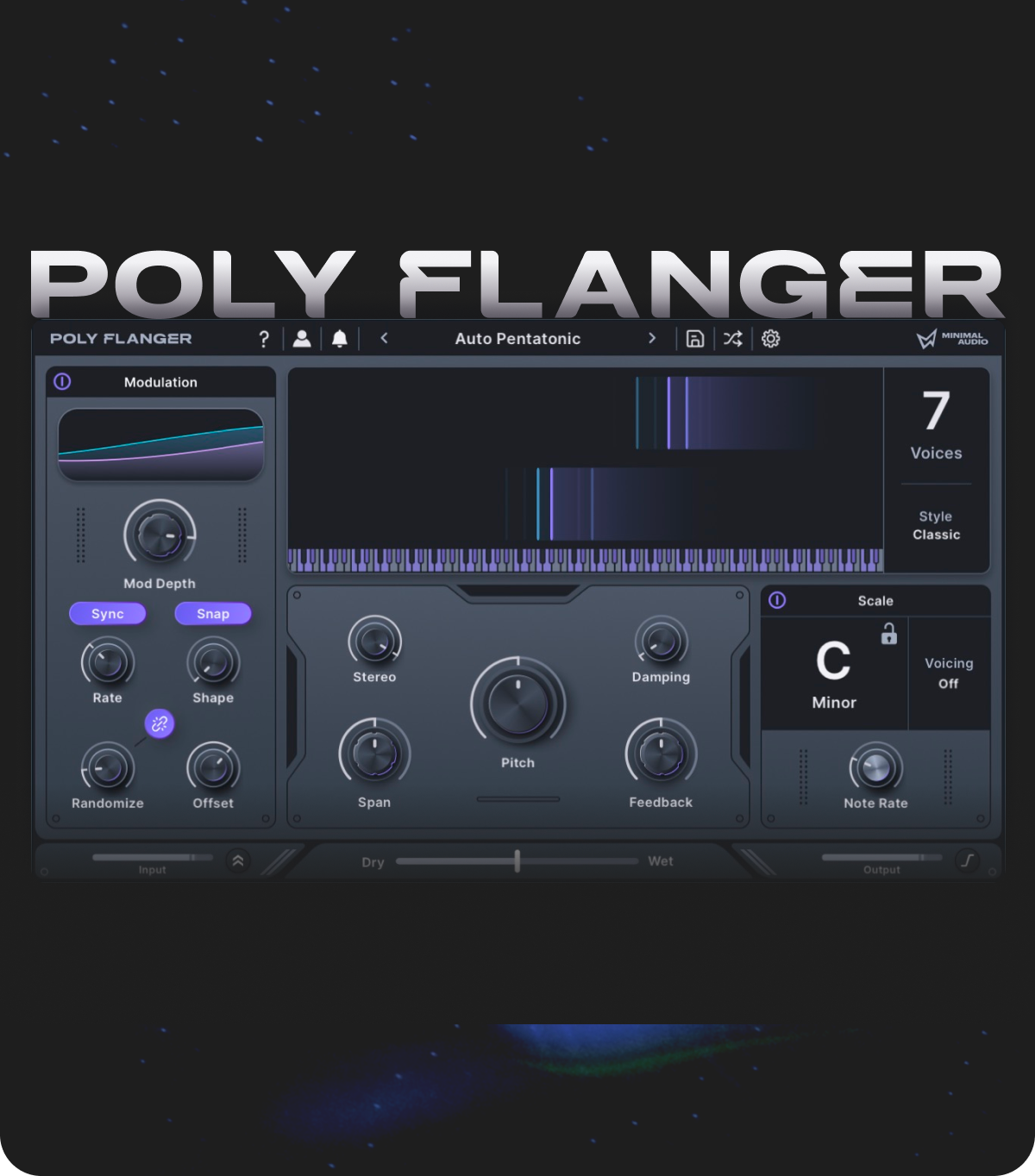
Poly Flanger started with a pretty straightforward question: What haven’t we done yet?
With Ripple Phaser and Flex Chorus already out in the world, flanger felt like the obvious next move. But instead of just adding another modulation effect to the catalog, we wanted to see how far we could push the idea without losing what makes a flanger a flanger.
In this conversation, head of product development Ben Wyss takes us through how Poly Flanger came together—where the idea for a musically-intelligent flanger came from, what got cut, and how a simple effect turned into our latest release.
Jake: Why Poly Flanger? Why did we want to go to a flanger specifically?
We've had a lot of modulation effects before Poly Flanger. Was this the next step? Was Poly Flanger an obvious hole in our catalog, or was it an effect you had an idea in mind for?
Ben: Yeah, it was kind of an obvious hole in terms of effects. Each of our core effects is supposed to have a special twist on fairly standard effects—like the ones you'd find on a synth.
So flanger was the only one that was missing. Maybe there's more we will do still, but that was the reason. The flanger came first. knowing we wanted to fill that gap, and then the question became—how can we make an interesting new flanger that isn't just some run-of-the-mill effect?
Jake: Can you expand on that a little bit? Where did that impulse lead you with Poly Flanger?
Ben: It's looking for opportunities. So each effect, whether it's Poly Flanger or any of our other plugins. They work a certain way, and in working that way, it can lend itself to different new ways that I think have been unexplored.
And with flanging specifically, a flanger is all about creating resonances through phase cancellation, but it's usually something that's just not controlled in a meaningful or at least, a musical way.
So exploring that concept, and exploiting what's already happening in the effect.
It really is a flanger. It's just been expanded on so that it meets this new use case that a flanger couldn't before.
And I'd say that's true for a lot of our core effects. Morph EQ is very much an EQ, but what if you could move your EQ points around?
Jake:
When we're working on this kind of stuff, a flanger is typically considered a modulation effect. But with things like the arpeggiation, stacking harmonies, and various other controls, you're pushing outside of that category. You're almost getting into spatial effects.
Are those intentional considerations? Or are you finding that along the way? When you're building these products, do you set out with something specific in mind, or do you discover what the controls can do as you go?
Ben:
It's definitely both. There's conceptualizing it beforehand, which is something I've gotten a lot better at over the years.
But at the same time, there's no substitute for exploring and figuring things out. There are nuances to how Poly Flanger works under the hood, and to an extent, some of the controls exist because it just sounds better that way.
The initial idea is very conceptual. After there's some validation and we know we have something cool, it becomes about exploring. How can I make this even better? Where does this initial path lead?
That's the trickiest part, because there are so many different directions you could take it. The beta testers will suggest a ton of things. “Wouldn't it be cool if it did this?” It could have easily been four times the size and much more confusing to use.
So you have to keep in mind why the project started. Just because something would be cool doesn't mean it should be included. I’d love to include every cool feature, but it would become overwhelming.
Jake:
So, to your point, it could have been four times bigger. Do you find that when you're working on Core FX, there's as much reduction as production?
Ben:
Yeah. For almost all of our products, besides maybe Current, that's true.
For Poly Flanger, there wasn’t a lot that got built and removed, but that definitely can happen. Sometimes we build something and realize it doesn’t sound as good as we wanted, or it’s confusing, or it just doesn’t serve the product. There’s limited space.
You have to be kind of ruthless about what gets cut. It has to be that way. Limitations are important — both during development and in messaging. Being upfront about what it’s intended to do and what it’s not.
Jake:
What’s your criteria for a cut? What pushes you to say, “We don’t need this”?
Ben:
It’s easier to think about what makes me really want something in. It has to clearly align with what the product is about — that one-sentence pitch or outcome.
If I open it and have that “wow” moment, and it aligns with the core idea, then it’s in.
If it doesn’t do those things, it’s probably out.
There are exceptions. Sometimes something is just cool, and it stays. But user experience matters. You don’t want someone opening it and getting confused or distracted.
There’s also limited space, so you prioritize the features that create that “wow” and clearly make sense with the product. If something ties into one of the primary features, it’s usually worth including. It’s when it starts to feel disconnected that it gets cut.
Jake:
In electronic music, maybe more than any other genre, a lot of art and innovation comes from misuse as much as use. As an instrument and effect designer, how does that factor into your process? Are you thinking about misuse, or are you hoping to be surprised?
Ben:
Ideally, I want people to misuse it and use it in different ways.
But the initial idea should be broad enough that even when it’s used in unexpected ways, it still connects back to that original concept. It can definitely be used in more ways than I could imagine, but it still results in that core idea.
Of course, there are ways to truly abuse it and get different sounds. But my goal is that it’s widely applicable within the framework we’ve defined. You can get creative and think outside the box, but it’s still connected to what it was meant to be.
Our beta testers are good at pushing things. That’s a natural part of the process. I don’t see misuse as the most important or least important part — it’s just part of it. Let people do it.
Jake:
I went down a huge rabbit hole on 303s once. I watched an interview with Tadao Kikumoto, who designed the instrument, and people asked him if he expected anyone to just turn the resonance all the way up. He laughed and said no.
Ben:
That actually makes me think about the design process. What I’m doing is creative too. There are artistic qualities to it.
In a way, I’m already abusing a flanger. I’m building it with extra functionality and asking, “Wouldn’t it be cool if it did this?” That’s similar to someone loading up one of our plugins and using it in a totally different way.
There have been times when we overlooked something it could do, and someone in beta or on the team pointed it out. That can make us rethink things. I try to get ahead of that because it can throw a wrench into development, but it can also be really valuable.
Once the product is out, though, if someone uses it in a completely different way, there’s not much we can do to respond to that directly.
Jake:
This might not apply as much to Core FX, but does that feedback loop come back into your process when you’re adding functionality in larger updates, like with Current?
Ben:
Absolutely. For flagship products, very much so.
With smaller Core FX products, space and scope are limited, so it’s not always feasible. But for larger products, we definitely try to include and listen to that kind of feedback.
Jake:
Is there anything you want to say about Poly Flanger? Any message you want to get across?
Ben:
I think Poly Flanger further refines what Minimal Audio is about, even though it’s a small product. It’s about musicians being creative in new ways.
There’s a clearer intent behind Poly Flanger than some of our earlier products. I want to continue refining that clarity going forward.
Start your 7-day Free Trial. to audition Poly Flanger in your own setup.
You can also demo the plugin along with the rest of our library with All Access. Click here to start your free trial.
Ready to try Poly Flanger for yourself?