

A full redesign of the official Resident Evil trailer—every impact, whisper, sting and sweep rebuilt from scratch, almost entirely with one set of tools.
Current handles the synthesis, Lucid does the granular design, Morph EQ and Swarm Reverb shape tone and space, and Emerge and Anomaly supply the source material. Here's how each one earned its place.
Simple on purpose
Across the session there's Current on eleven tracks, Morph EQ on twelve, Lucid on seven, and Swarm Reverb on four, plus another instance of Swarm running inside Current.
None of this is technically complicated, and that's deliberate. The whole approach comes down to two moves: find the right sound, then pitch and shape it to taste. Most of what you're hearing is a well-chosen piece of source material, nudged, bent, detuned and colored by ear until it sits in the picture.
What makes that possible is staying out of the weeds. The Minimal Audio tools are immediate enough that I can grab a grain rate, ride a Fine knob, or move a pitch without breaking the flow of the session. I can keep reacting to the cut instead of stopping to engineer every move.
The intention lives in the choices, not the complexity. Keep the mechanics simple and you stay in flow, and the flow is where good decisions happen.
The first ten seconds
Right out of the gate, the opening door "creak" is Lucid's granular engine chewing on a thin wood-friction sample. Seconds later, a Current factory instrument answers it: a viola playing a short tonal line against the creak.
That's the whole idea in ten seconds. Granular texture and melody trading off before the first hit even lands.
There's a story behind that viola, too. It's a one-of-a-kind instrument, hand-built by a guy living off-grid in Montana, that we recorded specifically for Current's factory library. So the string tension answering that granular creak isn't a generic string patch. It's that actual viola, recorded for Current and dropped straight back into a horror trailer.
Small world.
Current — the spine of the piece
Current is everywhere in this session: sub weight, rhythmic foley, synth textures, transitions, melodic instruments, and the Bass Stinger patch that drives the entire second half.
That range is part of why it became the backbone of the piece. The same instrument playing the viola in the opening seconds is also responsible for some of the trailer's heaviest sub-driven moments.
Around 0:20, two Current patches form the trailer's tick-tock pulse.
The low end comes from "Bass Cassette," a wavetable patch dropped low enough to work as both kick and bass. Sitting directly against it is "RE Drum Hit Reference," which sounds like a drum patch but is actually Current's Sampler loaded with a foley click.
I tucked the click's MIDI right up against the bass hits so the two sounds lock together: one engine carrying the low end, another creating the clock-like pulse above it. Same instrument, two completely different jobs.
A few seconds later, Current takes over the top of the mix.
A bright element sweeps in and holds before I pull it steadily downward with Keyboard Pitch Bend. There's no elaborate transition chain behind it. It's one sustained sound and one pitch gesture, dragging the top of the mix down into the next section.
Then comes the Bass Stinger.
It's one deep C, struck fifteen times. No sample, no melody. The hits begin roughly two seconds apart and gradually crowd together toward the climax while the velocities rise with them.
The sound itself stays almost entirely inside Current. Osc A is dropped an octave and stacked with the Sub, with Knock adding transient punch and Sub Drive pushed hard enough to turn the low end into a distorted stab. Polar Distortion adds grit, and Current's built-in Swarm Reverb gives each hit enough tail to bleed into the next.
Tone and Distort move across the pattern as it accelerates, so the sound gets more aggressive as the rhythm gets denser.
One note. Fifteen hits. Creates the spine of the entire back half.
Lucid — one plugin, three completely different jobs
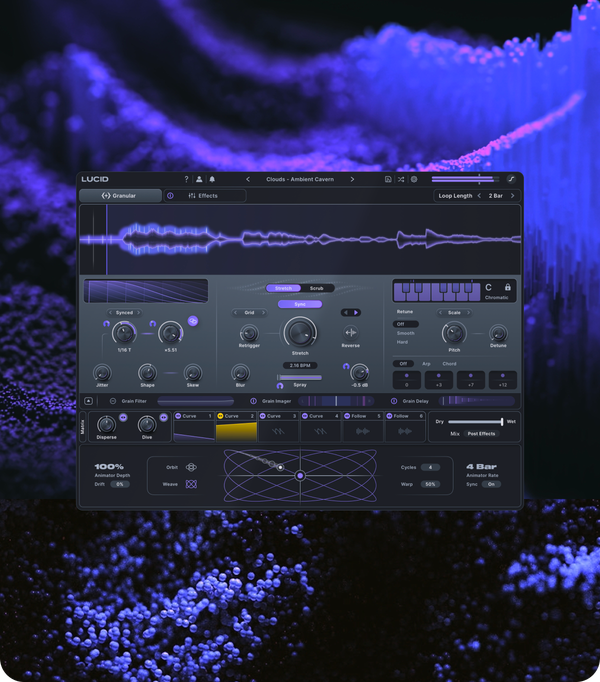
Lucid appears seven times, but the interesting part is how little those instances resemble one another.
The opening door creak isn't a door recording at all. It starts with a thin wood-friction sample with the grain rate stretched to roughly 493 ms and the grain size pulled down. At that point, you stop hearing a recording and start hearing something that feels like material under stress.
Two Follower modulators react to the dynamics of the wood itself and feed that movement back into the grains. Rather than imposing motion with an LFO, the source effectively modulates itself. That's what keeps the creak feeling reactive instead of mechanical.
At 0:31, Lucid takes a cello squeal somewhere else entirely.
Here the grain rate sits around 200 ms while pitch and grain timing move throughout the sound. It continually smears apart and pulls itself back into focus. You can still recognize the string underneath, but it never stays static long enough to read like a sample.
At the end of the trailer, Lucid does almost the inverse. A plain radio ambience becomes a grinding metallic drone by dropping the grain rate to around 1 ms, effectively freezing the sound, then crushing the bit depth.
The same engine that creates the fragile creak in the opening ends the piece as a frozen metallic mass.
Splinter, smear, freeze. Three completely different sounds, all determined by where the granular engine is pushed.
Nothing holds a pitch
If there's a secret ingredient to horror and trailer sound design, it's pitch instability.
Almost nothing is allowed to sit perfectly still. Sounds bend, drift, detune and slide because something that never fully settles naturally creates tension.
Two tools do most of that work. In Current, Fine handles the smaller microtonal movement. I can ride it just enough to pull a sustained sound off-center without turning it into an obvious pitch bend. Push further and Keyboard Pitch Bend takes over for larger gestures like the descent at 0:24.
In Lucid, Free pitch mode removes the scale entirely. Grain pitch can move continuously between notes instead of snapping back into tune, which is where a lot of the queasy character in the cello smears and metallic textures comes from.
It's a small discipline that defines the whole palette: let nothing lock to a pitch, and the sound design stays tense even when nothing is happening.
Morph EQ — tone as a moving target
Morph EQ is on twelve tracks, but almost never for corrective EQ.
I treat the Morph and Shift parameters as sound design controls and automate them through the source. On the impacts around 0:41, the spectral shape changes as each hit develops. On the music bed, Morph and Shift drift together so the entire texture keeps moving. A static curve sounds processed. A moving one feels like part of the sound.
Swarm Reverb — performing the space
Swarm Reverb appears four times as an insert, and again built into Current.
The standout is the "voices in the walls" whisper layer (0:04), where its Input is automated across ~60 points so the tail blooms and pulls back with the performance — the whispers leak forward, then the room swallows them.
It's also on the impact layer, providing the big hits their space, and it's providing the tail inside the Bass Stinger patch.
The space isn't a static send. It's another part of the performance.
Emerge & Anomaly — the designed material
A lot of the trailer's physical weight starts with Emerge and Anomaly.
Emerge supplies the large impacts: Spirit Hall, Portal Divide, Doom Split, Overload and Metal Chrysalis. Anomaly provides the metallic atmospheres and shrill textures underneath them, along with the cello squeal that later becomes raw material for Lucid.
These rarely go in solo—most of the biggest moments aren't one giant sample. They're three or four sounds stacked around specific jobs: one for the transient, one for the body, one for the tail. Lock those layers to the same rhythmic framework and they start behaving like one event instead of a row of one-shots.
And good processing only gets you so far if the source isn't there.
Nathan Wexler put a huge amount of work into building Emerge's source library, going as far as junkyards and abandoned warehouses to find the kinds of physical sounds you can't convincingly manufacture at a desk. He went the extra mile on Emerge, as did the full team on Anomaly.
A lot of the work in this session happens after the sample is loaded, but the first decision is still the most important one: start with something worth shaping.
The thread
One project, essentially one toolbox.
Current builds the backbone and plays the instruments. Emerge and Anomaly provide the raw material. Lucid breaks those sounds apart and rebuilds them. Morph EQ keeps the tone moving, and Swarm Reverb performs the space around everything.
And almost nothing stays still. Pitch, grains, tone, distortion, space and pattern density all move by hand until a static collection of sounds becomes a build.
That's really the process behind the whole redesign: find the right source, keep the mechanics simple, then keep pushing until the sound belongs to the picture.
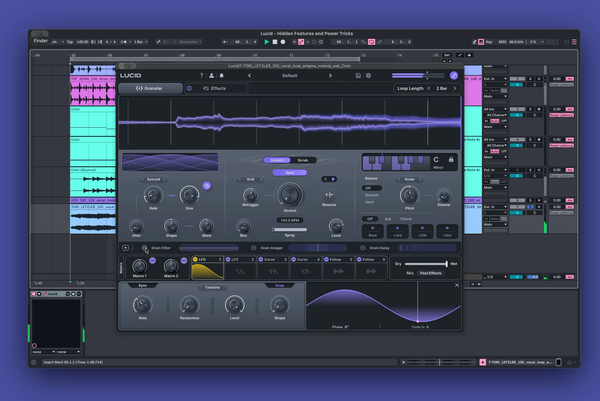
One last look at the full session, from the opening creak to the final freeze. Every layer, every movement, and every tool working together in real time.
The whole redesign, one toolbox, in a single pass.
The whole redesign comes back to the same idea: start with a strong piece of source material, keep the mechanics simple, and push the sound until it fits the picture.
Explore Lucid to add weight, texture, and dimension to your sounds, or get the Current Cinematic Bundle for a wider set of tools built for tension, texture, movement, and impact.
Ready to try Lucid for yourself?